
Time set aside for teaching became time to review the councilor's own system: AI support for a Fuji City councilor
Plural Reality LLC (Plural Reality) supports local council members in using AI. Our first case is our work with Yuki Yamaoka, a member of the Fuji City Council in Shizuoka.
What we supported was building a system that lets a councilor handle the information in their work with AI: the people they met, what was said in meetings, the next day's schedule, and policy developments from the national and prefectural governments. But Plural Reality did not build that system and hand it over. We observed his work, shared ways of thinking and of placing information, migrated his data, and offered remedies where he got stuck. Mr. Yamaoka built the system itself.
Our goal is that the councilor can keep running and correcting the system on their own after the support ends (self-reliance). We decide the depth and style of support according to each councilor's situation. With Mr. Yamaoka, we provided intensive support, including accompanying him on site.
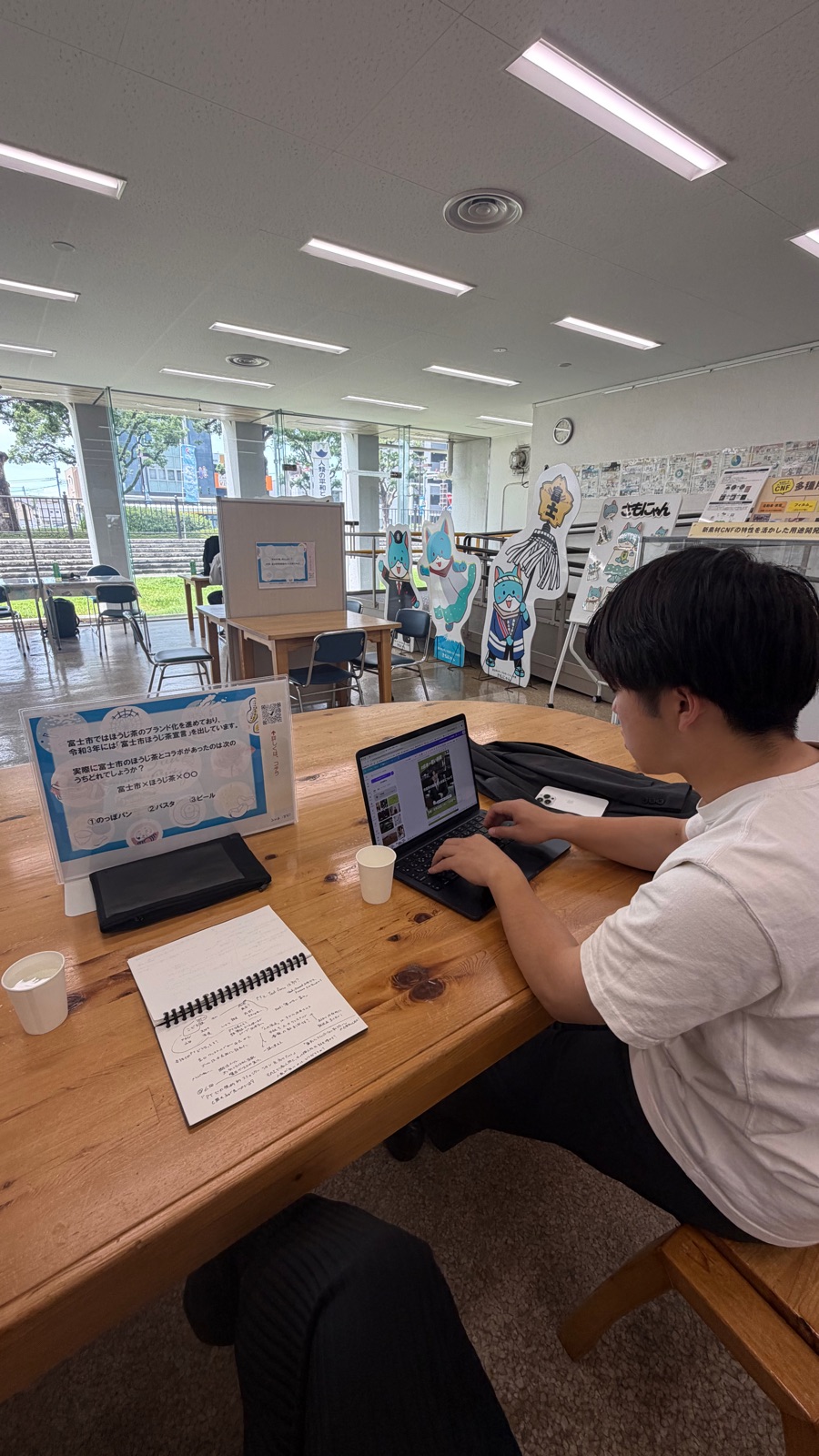
In Fuji City, we watched Mr. Yamaoka's everyday work from beside him.
Before: the friction lived inside "unavoidable everyday work"
Mr. Yamaoka is a member of the Fuji City Council in his twenties. Even before working with Plural Reality, he kept his work records in Notion and used Claude.
Our first involvement was in February. A Plural Reality member accompanied Mr. Yamaoka for three days and two nights as a secretary, looking for the parts of a councilor's activities that software could take over.
In March, under a service contract, we turned Fuji City's FY2025 and FY2026 general account budgets into data that allows year-over-year comparison. Until then, Mr. Yamaoka had laid the previous and current year's paper budgets side by side and marked new items, removed items, and items that visibly increased or decreased a lot. We made this work viewable as a table and delivered it in April.
When we talked in June, his problem was the copy-and-paste and manual updating between tools. He was trying to gather meeting records, about 1,300 business cards, and project management in Notion, but the business cards lived in a card-management app, meeting records in a transcription device, and correspondence across several email accounts.
June: accompanying a full day of work, and three suggestions
In June, a Plural Reality member visited Fuji City and accompanied Mr. Yamaoka through a full day of official duties. The goal that day was to watch from behind how he normally works, before building anything. Before the visit, we looked into the city hall departments he would visit that day: what each one is responsible for, and the issues he wanted to raise.
Mr. Yamaoka's day was a continuous stream: meeting people, listening, looking into past background, reading documents, preparing the next questions, keeping promises. Within it were frictions such as searching for the same person's information again and again, copying conversations to another place, and digging up past notes before the next appointment. He himself regarded all of these as "unavoidable everyday work."
After the visit, Plural Reality made three suggestions.
- Leave buffers before and after meetings: Without room between meetings, the next thing to do becomes vague. Before a meeting, decide what you want to get from that time; right after it ends, take care of thanks, next actions, and open questions.
- Make your own notes the skeleton, and let AI fill in: The transcripts of online meeting recordings and his own notes were not connected. If AI writes the minutes from scratch, the line between what was actually said and his own understanding blurs. Make the notes a person wrote the skeleton, and have AI fill in what is missing.
- Set aside blocks of time for outreach materials: He was making social media announcement materials between meetings, but doing it in those gaps has little effect. Block out an hour or more and turn it into a reusable template.
July: showing our work and how to place information
In July, Mr. Yamaoka came to Tokyo and spent about two hours watching, screen and all, how a Plural Reality member uses AI in everyday work. What we showed him was not how to use a particular app, but a way of seeing desk work as a flow: "input, context, transformation, review, write-back." Plural Reality calls this setup, which connects AI models to real work, a "harness."
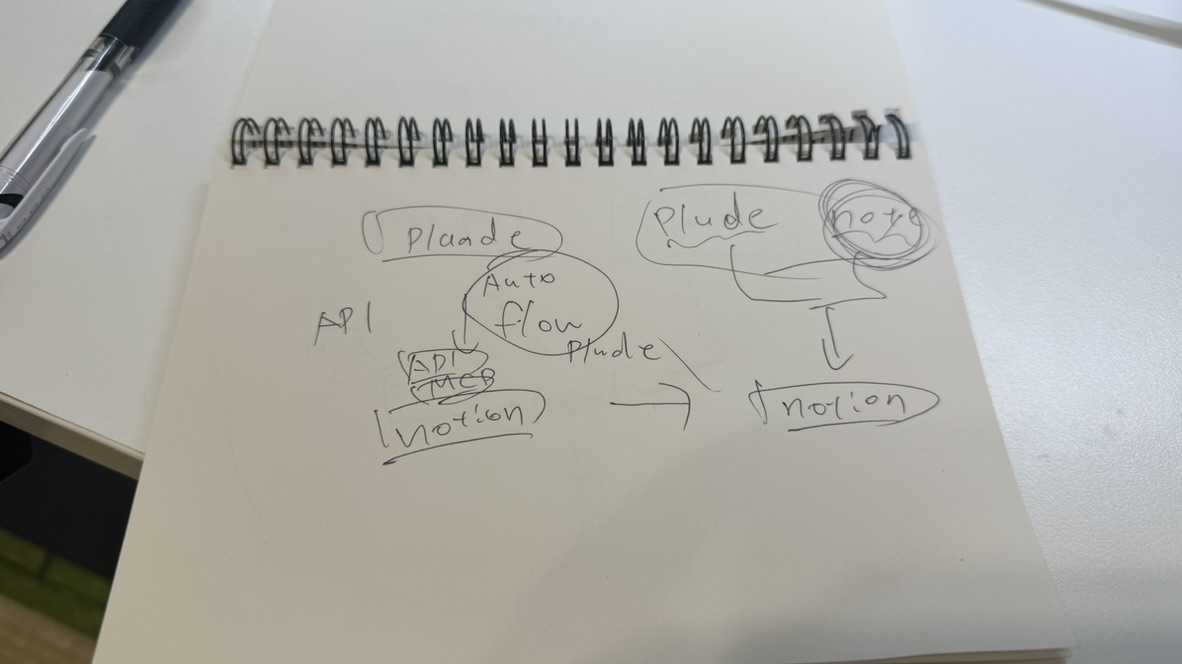
Before naming any app, we put the relationships between input, judgment, and output on paper.
We mainly conveyed four things that day.
- Don't hand the lead to AI: A person writes the skeleton, and AI writes only the additions. Mark what AI wrote in a different color. If AI writes everything, you lose track of where things are, and the information does not stay with you.
- Hold information as a web, not boxes: Instead of folder-like hierarchies, put people, meetings, tasks, and projects in one place and connect them with links. Meetings tie to people and people tie to tasks, so you can trace the relationships later.
- Put incoming information on a flow: Feed online meeting recordings, handwritten notes, and chats into an AI agent, and have it produce minutes and daily summaries automatically.
- Accumulate "who I talked with about what" per person: The most effective efficiency gain in a councilor's work is keeping meeting records tied to people.
Also in July, we moved the records Mr. Yamaoka had accumulated in Notion to Scrapbox, a note tool that connects pages through links. The migrated data came to 1,842 pages and 7,294 links. The numbers show the scale of the work, not the outcome. But only once an environment holds his own real data can he judge whether AI's output is correct.
In July we also worked out how the training would be set up. Mr. Yamaoka checked with the council secretariat and confirmed that, as long as the training is the main component and tool use is attached to it, it could be paid for from the councilor's research expenses (political activity funds). Plural Reality prepared the training outline, the estimate, and the invoice needed for the application.
What Mr. Yamaoka built himself
Right after the migration, from the end of July to early August, Mr. Yamaoka built systems fitted to his own work, by himself.
- Importing business cards: When business card data is imported, the system looks up the person's affiliation and social media and links them to past records.
- Matching online meeting recordings with handwritten notes: Keeping his own notes intact, it fills in topics missing from the notes using the transcript of the recording. The additions are marked in a different color.
- Next-day briefs: Linked to his calendar, it summarizes, for the people he will meet the next day, what he heard last time and points to watch.
- Policy digest: It gathers recent national and prefectural announcements that seem relevant to Fuji City and turns them into pages.
These are not features Plural Reality taught him to build one by one. He had also implemented, in his own way, the "make your own notes the skeleton, and let AI fill in" approach we suggested in June. What gave him the strongest sense of progress, he said, was seeing something a resident had told him resurface, by following links, in the preparation for a completely different appointment.
Plural Reality does not explain how far he got with "he was just smart." What we could observe were behaviors: testing with his own real data, reading AI's output and correcting it himself, looking for another way when something was slow, and applying the same principles to targets he had not been taught. Having a device and time to experiment, and concrete work he wanted to change, were also conditions that supported his self-reliance.
August: untangling the next sticking points in training
In August, we held a two-hour "Practical AI Training for Council Activities." It had been planned as time for Plural Reality to teach, but the first half became time for us to review the systems Mr. Yamaoka had built himself. The second half dealt with where he was stuck.
Handling tasks (GTD). His concern was that "Scrapbox is good for expanding ideas, but I don't know how to use it to manage work." Drawing on GTD (Getting Things Done), a task management method, we organized it as follows.
- Much of what goes on a to-do list is not a "task" you can start right away but a "project" that needs several actions. For example, "I want a spare council member badge" doesn't move as it is; it only progresses once broken into several actions.
- First put everything on your mind into one inbox, and once a week, cut tasks out of it.
- Choose the tool by what should remind you. If it is time, a calendar; if it is a place, a reminder that notifies by location.
- Split "waiting" into three kinds: waiting for a person, waiting for a procedure, and waiting for AI processing.
Technical sticking points. We offered a remedy for each of the following three.
- Each write to Scrapbox took 30 minutes: This was because AI was operating the browser screen to write. We suggested switching to a command-line tool that uses Scrapbox's API directly, without going through the screen.
- The AI agent stops when his own PC is asleep: We suggested setting up one machine that is always on, and running things by connecting to it remotely.
- The system does not learn from corrections: He corrects AI's output by hand every day, but those corrections were not going back into the system. The difference between what AI produced and what he actually kept is his own judgment, so feed that difference back into the next instructions. We told him to aim never to make the same correction twice.
In Mr. Yamaoka's words
After this series of efforts, Mr. Yamaoka describes what he expects from AI as follows.
"I want AI not only to shorten the time spent on the task in front of us, but to discover structures that we have accepted as everyday life and do not even recognize as problems. And then I want it to propose and implement systems and options that did not exist before."
On the results of building his own systems into his daily work, he says:
"When I open my computer in the morning, it has accurately summarized yesterday's activity history, so I no longer need to do detailed manual reviews."
He sums up where he is now and the area he wants to work on next as follows.
"In a councilor's work, the parts related to supporting relationships with people, including residents, and making the content of meetings stick have improved greatly. Next, I want to approach the parts related to policy work."
And he looks back on the impression of technology he gained through working with Plural Reality like this.
"I thought engineering rested on a dehumanizing philosophy of automation and mechanization. What I learned from them was the exact opposite: a deeply human philosophy of cutting the time spent on simple tasks so that we can spend more time on human activities."
Next: when support should end
Through our work with Mr. Yamaoka, Plural Reality has set the following six "conditions for ending support."
- The first task runs end to end on the councilor's own real data.
- The councilor can read the AI's output and correct it with reasons.
- The reasons for corrections can be fed back into the next round's steps.
- Using the same principles, the councilor can build a second and third task on their own.
- The councilor discovers uses the supporter did not know about.
- When something is risky, or the cost does not pay off, the councilor can decide to stop.
These are not conditions for locking a client into a particular product. They are conditions for the councilor to keep learning and improving their work on their own, even after the supporter is no longer beside them. Mr. Yamaoka's next interest has moved from relationships and meeting records to policy work.
Every councilor's work is different, and so are the data they hold and the everyday friction they face. So rather than a uniform study session that teaches everyone the same content, we suspect it works better to talk briefly, fitted to each person's work, and untangle the points where they get stuck as they actually work through them. That is the hypothesis Plural Reality holds today.
For those considering a similar effort
Plural Reality helps councilors handle the information in their work by connecting it with AI. Rather than building a system and delivering it, we support them until they can build it and keep correcting it themselves.
We decide the depth of support according to each councilor's situation. For a case where, after two conversations, the councilor built his own system for council questions, see the case of Yuki Hozumi, Chuo City Councilor.
You can reach us through the contact page.
I thought engineering rested on a dehumanizing philosophy of automation and mechanization. What I learned from them was the exact opposite: a deeply human philosophy of cutting the time spent on simple tasks so that we can spend more time on human activities.
Project overview
- Location
- Fuji City, Shizuoka
- Client
- Yuki Yamaoka, Fuji City Councilor
- Period
- February 2026 –
Table of contents
Contact Form
Pricing by individual quotation
We prepare a quotation based on the scope of work, scale of use and support required. Tell us about the challenge you are working on.