
Using AI to Overcome the Challenge of Translating Residents’ Voices into Policy
Yosano Town lies in the Tango region of northern Kyoto Prefecture and is known for producing Tango chirimen silk crepe. Here, residents gathered for the Yosano Future Forum, a series of public discussions held to help shape the town’s Third Comprehensive Plan.
The initiative was organized by Yosano Town with support from KOSO NIPPON, a Japanese policy think tank. Plural Reality provided AI facilitation support as a technology partner to KOSO NIPPON, helping translate residents’ voices into policy.
The views expressed in public dialogue are diverse and candid, which can make them difficult to incorporate directly into government policy. Broad listening, powered by Plural Reality’s suite of AI tools, helped bridge that gap.
- Time required to produce meeting minutes: A process that previously took approximately one week was completed in minutes
- Automated proposal drafting: Structured draft proposals were generated automatically from transcripts and improvement proposal sheets
- Higher participant satisfaction: The share of respondents rating the meeting “very good” rose from 47.4% at the third meeting to 59.1% at the fourth
- Greater personal engagement among residents: One participant described a change in behavior: “I started using every available channel—including the town’s social media, YouTube channel, and Yosano newsletter—to learn more about the town”
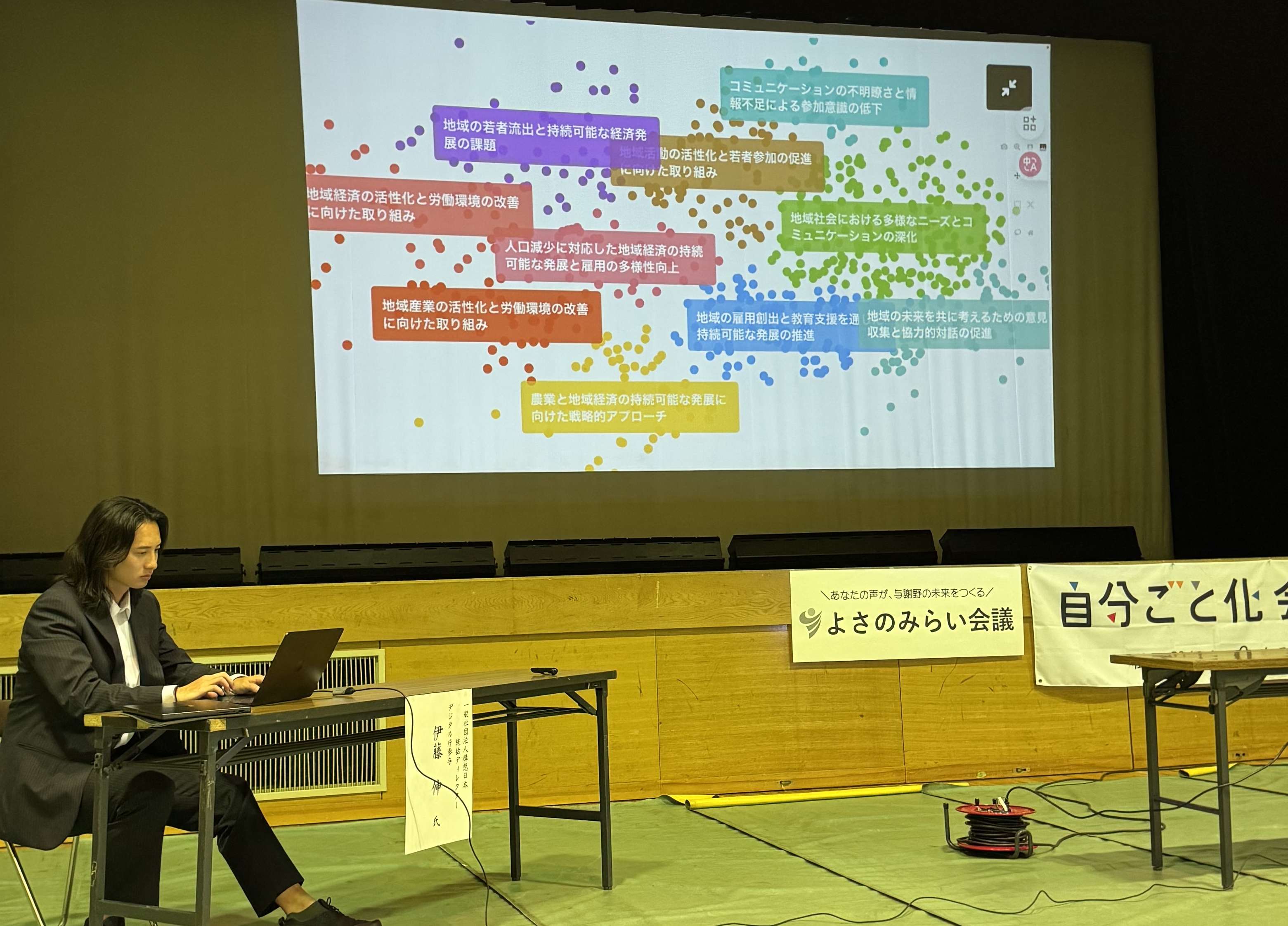
The Yosano Future Forum in Yosano Town, Kyoto Prefecture
Background: Yosano Town and Its Third Comprehensive Plan
Yosano is a town of approximately 20,000 people in the Tango region of northern Kyoto Prefecture, comprising the three areas of Kaya, Iwataki, and Nodagawa. It has more than 300 years of history as a center for Tango chirimen silk crepe and remains rich in natural beauty and traditional culture. Like many other local governments, however, it faces a declining and aging population and a falling birth rate.

Presentation ceremony for the Yosano Future Forum (Source: Yosano Town official website)
In fiscal year 2025, Yosano Town began preparing its Third Comprehensive Plan. The plan will guide the municipal government for eight years beginning in fiscal year 2027 and set out a vision for the town ten years into the future. To incorporate residents’ voices directly into the planning process, the town organized the Yosano Future Forum, a public dialogue forum whose participants were selected at random.
Invitations were sent to 5,000 randomly selected residents aged 16 and over. A total of 43 people took part, ranging from teenagers to people in their seventies and older, and including company employees, civil servants, self-employed people, students, and retirees.


Yosano Future Forum flyer (Source: Yosano Town official website)
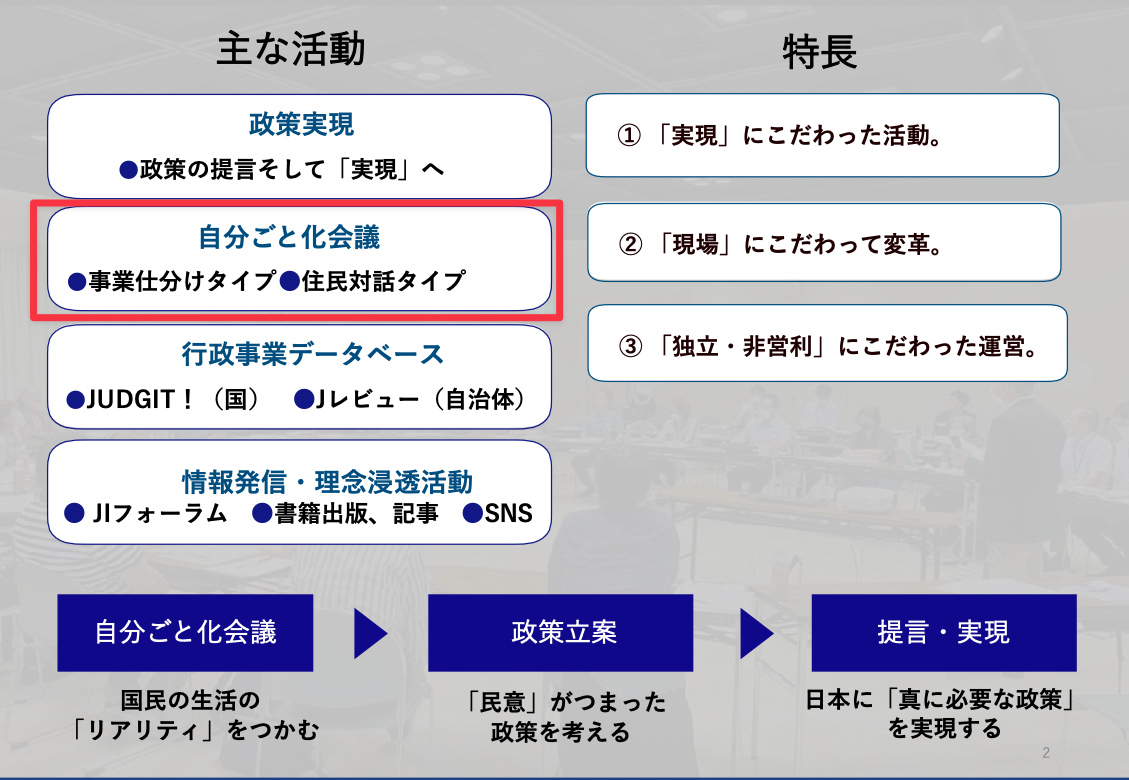
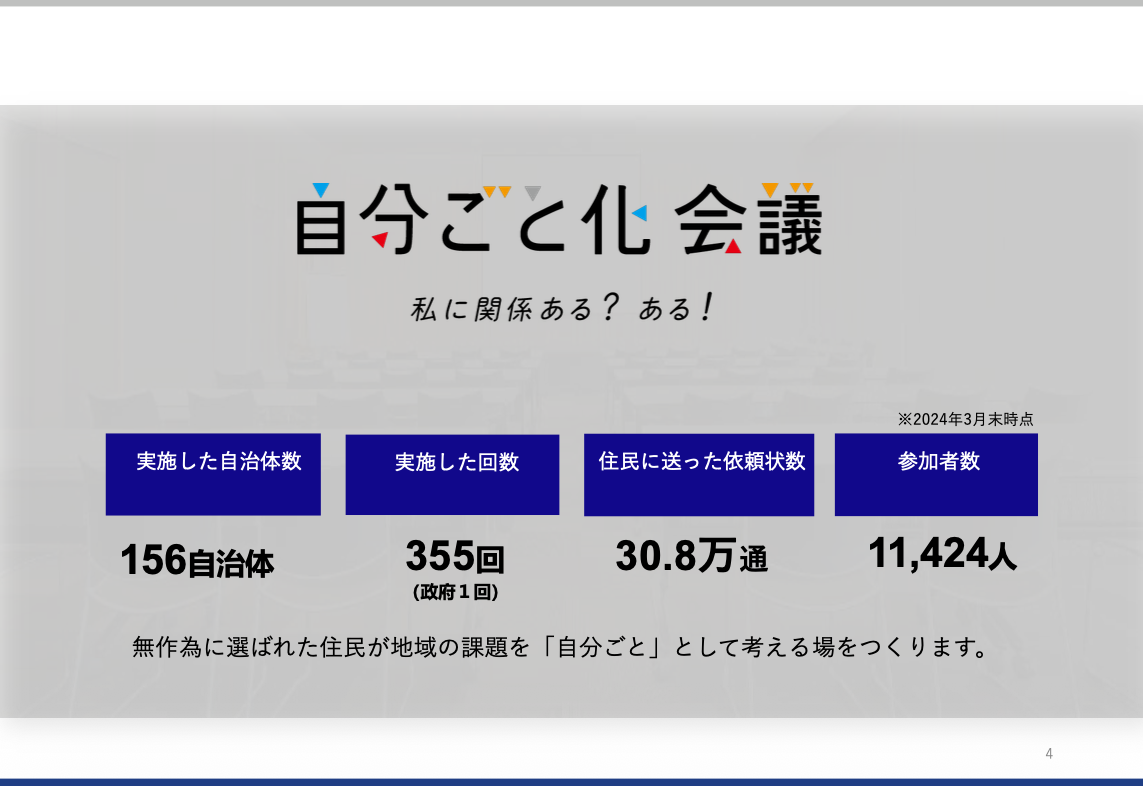
KOSO NIPPON, which has extensive experience designing and running “Residents Councils” throughout Japan, joined the project as its operational partner.

Founded in 1997, KOSO NIPPON describes itself as an “action-oriented think tank” and has built extensive expertise in government program reviews and resident councils.
Designing the Yosano Future Forum
The Yosano Future Forum was designed as a series of four meetings. Each meeting advanced the discussion to the next stage, culminating in a review of the proposals at the final session.
| Meeting | Date | Venue | Topic |
|---|---|---|---|
| 1 | September 14 (Sun.) | Chiyukan Lifelong Learning Center | Introduction to the Comprehensive Plan’s purpose and themes |
| 2 | October 13 (public holiday) | Nodagawa Workpal | Identifying issues by theme |
| 3 | November 9 (Sun.) | Genkikan | Proposing solutions |
| 4 | December 7 (Sun.) | Nodagawa Workpal | Reviewing the proposals |
Each meeting ran for four hours, from 1:00 p.m. to 5:00 p.m. A separate forum for junior and senior high school students was also held on October 12.

The Yosano Future Forum for junior and senior high school students (Source: Yosano Town official website)
Three Working Groups and Their Discussion Topics
Participants were divided into the following three working groups.
- Jobs and Industry Working Group: Revitalizing local industries, including Tango chirimen; broadening career options; and creating employment opportunities that make young people want to return
- Community Life Working Group: Maintaining public transportation; considering whether to consolidate municipal offices; securing infrastructure for daily life; and examining digitalization and the future of public services
- People and Community Working Group: Embracing diversity; creating places for community interaction; living alongside new residents; and supporting people with disabilities
Each working group was assigned a facilitator from KOSO NIPPON.
At the first meeting, participants were also introduced to two perspectives that would guide discussion across all three groups.
- Building systems that can sustain the community even as the population declines
- Building systems that prevent or slow population decline
The three themes were closely connected. As one participant observed, “The themes of the three working groups are interconnected, so similar views have emerged in each.” The ability to integrate perspectives across the groups was crucial to the quality of the final proposals.
The Challenge: Translating Residents’ Voices into Policy
The fundamental challenge facing the Yosano Future Forum was the process of turning a wide range of resident perspectives into proposals that the municipal government could act on—in other words, the challenge of translation.
Public dialogue produces a remarkable variety of opinions. During the Community Life Working Group’s four-hour discussion at the second meeting, participants covered dozens of topics, including inconvenient public transportation, the proposed consolidation of municipal offices, the lack of retail facilities, and both hopes and concerns surrounding digitalization.
Traditionally, these discussions were organized on whiteboards, after which a coordinator manually compiled a proposal from the meeting minutes and improvement proposal sheets. This process presented several problems.
- Heavy reliance on individuals: The quality of the proposals depended greatly on each facilitator’s skills and experience. Nuance could be lost during summarization, creating a risk that residents’ voices would be diluted.
- Time burden: Transcription, summarization, structuring, and documentation required an enormous amount of time. Producing the minutes alone had previously taken approximately one week.
- Effort required for comprehensive coverage: Capturing every opinion without omission and organizing the material coherently demanded considerable manual effort.
- Difficulty of integration: It was extremely difficult to synthesize parallel discussions from three working groups into a coherent set of proposals.
One participant wrote the following in the survey after the third meeting.
“It felt like an environment where it was difficult to speak unless the facilitator put considerable thought into how the discussion was run. I think some people found it hard to express their views.” (Male participant in his thirties)
Another participant offered a different perspective in the same survey.
“The AI-generated summaries are very easy to understand. Being able to see at a glance, in visual form, what views have been expressed makes it easier to organize my thoughts during the meeting.” (Female participant in her thirties)
Together, these comments succinctly illustrate both the limitations of the conventional approach and the potential of AI support.
The Solution: An Ecosystem of AI Tools
Plural Reality adopted an integrated approach, assigning the appropriate AI tools to each phase: before, during, and after the meetings. A defining feature of the project was that it did not depend on a single tool, but instead created an ecosystem that drew on the strengths of each.
Before the meetings: NotebookLM gave facilitators and participants shared context on local issues.
- An interactive knowledge base was built from more than 30 official town documents.
- During meetings, it could immediately answer questions such as, “How is this issue addressed in the town’s existing plans?”
During the meetings: Recograph and Broad Listening AI helped visualize discussions and identify overall trends.
- Recograph turned each working group’s discussion into graphics in real time, helping participants understand the overall picture.
- Broad Listening AI used word clouds to provide an overview of broader trends.
- Limitless automatically generated real-time meeting minutes.
After the meetings: A proposal-generation AI turned residents’ voices into structured proposals.
- Transcript data and improvement proposal sheets were combined and organized by working group.
- Content was automatically classified into “Current issues → What residents can do → What the community can do → What the municipal government can do.”
- Draft proposals were generated automatically for facilitators to revise and expand.
Before the Meetings: Establishing Context
NotebookLM made it more efficient to give facilitators and participants the background knowledge they needed.
More than 30 official documents were loaded into NotebookLM to create an interactive knowledge base. These included materials related to Yosano Town’s Comprehensive Plan, such as its population vision, fiscal plan, government digital transformation plan, community development survey report, regional public transportation plan, and regional plan for preserving and using cultural properties.
This enabled facilitators to answer questions during the meetings—such as, “How is this issue addressed in the town’s existing plans?”—and accurately supply the context needed for discussion.
During the Meetings: Real-Time Support
Several AI tools operated in parallel during the meetings, supporting the discussion in real time.
Limitless (Real-Time Meeting Minutes)
Limitless transcribed the meetings in real time and automatically generated minutes. Previously, recordings had to be taken away and transcribed, with the minutes taking approximately one week to prepare. The minutes were now ready almost as soon as each meeting ended.
Recograph (Real-Time Graphic Recording)
Introduced at the third meeting, Recograph transcribes, structures, and visualizes speech as graphics in real time, giving participants a visual representation of how the discussion is unfolding. The tool was developed as a project selected for the IPA Exploratory IT Human Resources Project, and this forum served as one of its field trials.
The facilitation team found that “the conversion from text to graphics was easy to read” and that the tool was “useful for facilitators.”
Broad Listening AI
Broad Listening AI visualized the views of all participants as a word cloud, providing an overview of the discussion’s broader trends. It was used to identify patterns among the “silent majority” who did not express their views aloud.
After the Meetings: Structuring Ideas and Drafting Proposals
Proposal-Generation AI
This system combined transcripts from each meeting with the improvement proposal sheets and automatically generated draft proposals for each working group. It distilled the material into five main proposals per group, each organized as “Current issues → What residents can do → What the community can do → What the municipal government can do → Other.”
Instead of writing proposals from scratch, facilitators revised and expanded the AI-generated drafts. This substantially reduced the time required while ensuring that residents’ voices were represented without omission.
How the Process Evolved Across Four Meetings
Over four months and four meetings, both the participants and the quality of the discussion changed noticeably.
Meeting 1 (September 14) → Meeting 2 (October 13): Building Relationships
The first meeting focused on explaining the purpose of the forum and allowing participants to meet one another. The second marked the start of substantive discussion by theme, as well as the full launch of Plural Reality’s AI support. At this stage, the main outcome was the relationships formed among participants.
Meeting 2 → Meeting 3 (November 9): Deepening the Discussion
Participants became more active at the third meeting. One said, “By the third working-group session, many more views were being expressed, and we had started talking during the breaks as well.”
“The discussion kept getting deeper and closer to the heart of the issue.” (Female participant in her thirties)
Meeting 3 → Meeting 4 (December 7): Finalizing the Proposals and Deepening Personal Engagement
At the final meeting, participants reviewed and revised the AI-generated draft proposals themselves. One participant’s comment captures the value of the process: “What we had written on the improvement proposal sheets was included as is, without paraphrasing. It was also very helpful that the content was presented in bullet points and organized under clear headings.” Participants were able to confirm for themselves that their voices had been incorporated into the proposals without distortion. KOSO NIPPON had always followed the principle of recording residents’ views without paraphrasing them, even when grouping similar views together. AI accelerated the work of structuring the content and producing drafts while preserving that principle.
“Since I started taking part in the Yosano Future Forum, I have begun using every available channel—including the town’s social media, YouTube channel, Yosano newsletter, and cable television—to learn more about the town. Things I had previously seen as someone else’s concern, simply thinking, ‘I wish it were this way,’ now make me consider what I can do myself and which tools I can use.” (Female participant in her twenties)
This comment shows that the forum did more than collect opinions: it prompted participants to change their own behavior.
Results
Quantitative Results
Participant satisfaction increased with each meeting. The share of respondents who rated the experience “very good” rose substantially, from 47.4% at the third meeting to 59.1% at the fourth.
Third Meeting Survey Results (20 respondents; each question was calculated from valid responses, excluding unanswered items)
| Item | Result |
|---|---|
| How would you rate your experience of participating? | “Very good” 47.4% + “Good” 47.4% = 94.7% positive |
| Did your understanding of the issues deepen? | “Deepened greatly” 47.4% + “Deepened to some extent” 47.4% = 94.7% reported deeper understanding |
| Was it easy to express your views? | “Very easy” 20.0% + “Easy” 50.0% = 70.0% found it easy |
| Did you gain insights or learn from other participants’ views? | “A great deal” 64.7% + “To some extent” 35.3% = 100% gained insights |
Fourth Meeting Survey Results (22 respondents)
The share of respondents rating the meeting “very good” was 59.1% (final figure compiled by the town).
Operational Efficiency Results
- Meeting minutes: Previously approximately one week → automatically generated within minutes of the meeting ending
- Draft proposals: Previously written from scratch by facilitators → generated automatically by AI, allowing facilitators to focus on revisions and additions
- Main proposals generated: Five per working group × three working groups = 15 structured policy proposals
Qualitative Results in Participants’ Own Words
Assessments of Facilitation and Operations
“The facilitator respected each speaker and treated every opinion sincerely. He was an excellent moderator, especially for someone so young.” (Male participant in his sixties)
“Mr. Sakamoto and Mr. Takagi did an excellent job coordinating the meetings. I do not think the discussion would have gone nearly as deep with only the townspeople and municipal staff. We were able to have a better discussion precisely because people brought perspectives and views from their respective positions.” (Female participant in her twenties)
Confidence in the Discussion Process
“What we had written on the improvement proposal sheets was included as is, without paraphrasing. It was also very helpful that the content was presented in bullet points and organized under clear headings.” (Female participant in her twenties)
“By the third working-group session, many more views were being expressed, and we had started talking during the breaks as well. Hearing so many different perspectives made it easier for me to share my own.” (Male participant in his fifties)
Deepening Personal Engagement
“It was only because the Yosano Future Forum existed that I realized I had been thinking about Yosano myself. Despite the town’s shortcomings, I was able to hope for a better future and express that hope. It made me realize how much I love Yosano.” (Female participant in her forties)
“People from neighboring cities also attended or showed interest in this Yosano Future Forum. Looking ten years ahead, it may become unrealistic for Yosano Town to discuss and solve its challenges entirely on its own.” (Male participant in his thirties)
Candid Feedback on the Use of AI
“The collaboration with the Digital Agency gave us access to information about the future of digitalization. It was fascinating and educational to experience a system that used AI summaries to condense the meeting as it unfolded.” (Female participant in her twenties)
“The event itself seemed to run smoothly, but I think the information could have been presented more clearly if the AI initiatives had been used more effectively.” (Female participant in her twenties)
This candid feedback shows that there is still room to improve how the AI tools are used, and provides valuable guidance for the next implementation.
Lessons and Reflections
The most important lesson from this project offers one answer to a central question: How can we design a system that carries residents’ voices into policy without diluting them?
The Consistent Principle of “No Paraphrasing”
Many participants said that the draft proposals reflected and organized their views “fully” or “to some extent.” This confidence was rooted in a commitment not to distort residents’ voices: as one participant noted, “What we had written on the improvement proposal sheets was included as is, without paraphrasing.” Even before introducing AI, KOSO NIPPON followed the principle of recording residents’ views without paraphrasing them. AI-assisted structuring supported the work while preserving that principle.
AI-assisted structuring organized the material based on the participants’ actual statements and made it possible to uphold the existing “no paraphrasing” principle in far less time. Residents’ sense that “my voice was heard as I expressed it” strengthened their confidence in the process and encouraged deeper personal engagement.
The Value of Ecosystem Design
Rather than searching for a single tool that could do everything, it proved effective to assign the best tool to each phase before, during, and after the meetings. The flow of data needed to be considered from the design stage: Limitless transcripts became input for Recograph, while those same transcripts and the improvement proposal sheets became source material for the proposal-generation AI.
The Changing Role of the Facilitator
AI provides support; it does not replace the facilitator. Guided by the principles of AI facilitation, the process incorporated three layers of review: facilitators reviewed the drafts, participants gave final confirmation, and the original text was preserved. With AI handling cognitively demanding tasks such as transcription, structuring, and visualization, facilitators were free to focus on work only people can do: reading participants’ expressions and managing the atmosphere in the room.
For Organizations Considering a Similar Initiative
The approach used in this project is particularly effective in the following circumstances.
- The forum involves residents selected at random or through an open call
- It consists of a series of meetings rather than a single session, where the impact would be limited
- Residents’ voices need to be compiled into a structured deliverable such as a proposal or report
- Multiple working groups or themes need to be integrated across the forum
Plural Reality works with KOSO NIPPON to provide similar support to several local governments. We offer end-to-end support, from designing the dialogue process to producing the final deliverables.
Would you like to learn more about this use case? Are you considering a similar implementation? Contact Plural Reality.
What we had written on the improvement proposal sheets was included as is, without paraphrasing. It was also very helpful that the content was presented in bullet points and organized under clear headings.
Project overview
- Location
- Yosano Town, Kyoto Prefecture
- Client
- Yosano Town, Kyoto Prefecture
- Partner
- KOSO NIPPON
- Period
- September–December 2025 (approximately four months)
Table of contents
Contact Form
Pricing by individual quotation
We prepare a quotation based on the scope of work, scale of use and support required. Tell us about the challenge you are working on.