
Building a City Where Children and Young People Can Fulfill Their Dreams, Together with Citizens: Higashiosaka City's Effort to Uncover Honest Views Through Conversational AI
To reflect citizen input in its “Children and Youth Plan,” Higashiosaka City held the “Higashiosaka Regional Revitalization Roundtable,” a Residents Council where citizens speak directly with one another. To hear from residents, 49 people with diverse backgrounds, ranging from junior high school students to people in their seventies, took part. At the meetings, AI tools including Future Proposal Talk, a conversational AI developed by Plural Reality, were used to explore each participant's honest views in depth.
Higashiosaka City hosted the initiative, while KOSO NIPPON, a Japanese policy think tank, provided operational support, designing and facilitating the meetings. As a technology partner to KOSO NIPPON, Plural Reality supported the initiative behind the scenes by integrating and operating multiple AI tools to explore citizen input in greater depth.
Conventional surveys and face-to-face meetings sometimes fail to uncover participants' honest views and latent needs. Alongside the Residents Councils, where residents discussed issues as stakeholders, we therefore deployed several tools—including the conversational AI “Future Proposal Talk” and NotebookLM—at different stages of the meetings to make citizens' values visible beyond their surface-level requests.
The following results were observed.
- Deeper exploration of values:
- By asking questions such as “Why do you think that?” and “What specifically do you mean?”, AI helped participants move step by step toward articulating essential values that were difficult to express face to face.
- Through repeated dialogue with AI, participants worked together with the system to put into words the values and context behind surface-level dissatisfaction.
- Connections to existing initiatives:
- NotebookLM instantly presented the city's comprehensive plan and related initiatives, helping participants discover connections to government efforts they had not known about.
- It enabled “on-demand learning,” allowing participants to consult needed information in real time during meetings.
- Encouraging behavioral change:
- Participants shifted from one-sided requests for the government to fix something toward proactive proposals about what they themselves could do.
- Active youth participation:
- Younger generations, including junior high school and university students, actively articulated their own views through dialogue with AI.

Panoramic view of Higashiosaka City (Source: Higashiosaka City Official Website)
Background: How Can We Hear What Children and Young People Really Think?
Higashiosaka is a core city in eastern Osaka Prefecture with a population of approximately 480,000. Although the city has recorded net population inflows for six consecutive years, families raising children have tended to move away.
Against this background, Higashiosaka City began developing its Children and Youth Plan. The plan presents Higashiosaka as a city where children and young people can freely envision their dreams as the city's aspiration. At the roundtable where concrete details were discussed, participants considered the importance not only of government involvement but also of citizens taking an active role themselves.
What children and young people truly want cannot be seen from inside government alone. The city needed to hear the frustrations and hopes experienced in daily life by residents—especially young people and families raising children—as well as latent needs that had yet to be put into words.
Higashiosaka City therefore adopted a Residents Council in which citizens from diverse generations speak directly with one another, unlike conventional public-comment procedures or advisory councils. The intent was to substantively reflect citizen input in the plan.
Designing the Themes of the Children and Youth Plan
The plan consisted of two main pillars.
Support for the Development of Children and Young People (Five Themes)
This pillar designs seamless support appropriate to each stage of a child's development across education, welfare, and local community life. It covers people under 30; those in post-adolescence (ages 30 to under 40) who experience difficulty in life; and the parents, families, and supporters who directly support the children and young people concerned.
Measures to Address the Declining Birthrate (Three Themes)
This pillar considers how to create an environment in which younger generations can confidently build families through the life stages of marriage, pregnancy, childbirth, and child-rearing. It is comprehensive, encompassing not only financial support but also housing, working styles, and the nature of community life.
What concerns did citizens have about these themes? Beyond making requests of government, what actions could citizens themselves take? The meetings placed particular importance on fostering a sense of personal ownership.
Relationships Between the Client and Partners
The project brought together the following three parties.

- Higashiosaka City (Host): The entity responsible for developing the plan. It established the meetings and provided relevant city data and policy information.
- KOSO NIPPON (Operational Support): A general incorporated association specializing in participatory policymaking. It handled meeting design, facilitation, and deliverables.
- Plural Reality (Technology Partner): As KOSO NIPPON's technology partner, it supported the integrated operation of conversational AI tools and improvements to meeting design.
Plural Reality's role was not to become the “main actor” in the meetings, but to use technology to help KOSO NIPPON's facilitators and participating citizens engage in deeper dialogue. AI was an auxiliary tool; people always retained control of the discussion. This principle was upheld throughout.
Challenge: How Can We Draw Out Deeper Citizen Input?
The most fundamental challenge in designing these meetings was how to draw out the depth of citizen input.
Conventional methods of public participation have the following structural limitations.
- Surveys: Multiple-choice answers are easy to aggregate but insufficient for understanding respondents' context and background. Even with free-response fields, many people stop after only a few lines.
- Conventional workshops: Depending on facilitation, discussion can be dominated by more vocal participants, while people who are less comfortable speaking and younger participants may hold back. Fragmented opinions may be collected, but it is difficult to explore the underlying values.
- Public comments: The system can formally collect opinions, but submissions tend to come disproportionately from a limited group with strong interest in the subject.
Because participants ranged from junior high school students to people in their seventies and varied widely in living circumstances and access to information, the meetings needed an environment in which everyone could participate on equal terms.
Issues Repeatedly Raised by Residents
At the first meeting on October 5, 2025, participants repeatedly raised the following issues.
- Deteriorating road conditions: Concerns about everyday travel safety, including “Faded lane markings are dangerous” and “The uneven roads make cyclists feel unsafe.”
- Inconvenient north–south transportation: Railways run east–west, but there are few north–south options, making travel beyond stations costly and time-consuming.
- Access to emergency medical care at night: Hospitals in the city have difficulty accepting nighttime emergencies, so many patients are transported outside the city. People with intractable diseases may also have to seek treatment outside the prefecture.
- Lack of recreational facilities for teenagers: There are few places in the city where young people can gather, so they travel to places outside the city such as Namba and Yao.
- Safety on streets at night: Concerns including “The streets are dark at night” and “There are too few sidewalks,” particularly regarding the safety of women and children.
These views raise important issues in themselves. To incorporate resident input into the plan, however, dialogue needed to go beyond these surface-level problems to the level of values: why the issue matters and what kind of life residents want to realize.
The Barrier to Moving from Requests to Action
Conventional public-participation methods often follow a familiar pattern: participants say, “We want the government to do X,” and officials respond, “We will consider it.” This may appear to be effective citizen participation, but both sides often remain passive.
Residents Councils are specifically designed to overcome this passive structure. Residents discuss what they themselves can do and record their ideas on improvement-proposal sheets. Citizens thereby become stakeholders in solving problems and build a collaborative relationship with government. Yet drawing out sufficient reflection from every individual within limited meeting time is not easy and can depend on each coordinator's skills and experience.
- Facilitators have limited time to explore every individual's views in depth.
- In group discussions, concern about others' reactions can make honest views difficult to express.
- Answering “What can I do?” immediately requires reflection.
We decided to enlist AI to overcome these structural barriers.
Solution: Integrated Operation of Conversational AI Tools
Rather than relying on a single AI tool, Higashiosaka City's Residents Councils adopted an integrated approach that placed the most suitable tool at each stage.

Directions for the use of AI in Residents Councils (Source: Internal materials)
The role of each tool is organized below according to the meeting flow.
Before and during meetings → NotebookLM: Interactive support for understanding government documents. AI learned the city's comprehensive plan and related initiatives and answered participants' questions in real time.
During breaks and after meetings → Future Proposal Talk: Individual AI dialogue for deeper exploration of values. Each participant spoke one-on-one with AI using a smartphone.
During meetings → Recograph: Real-time visualization of group discussions, simultaneously transcribing and structuring discussions at multiple tables.
After meetings → Limitless: Automated generation and analysis of meeting minutes. Highly accurate transcription and summarization substantially reduced the burden of preparing materials.
Clearly designing what each tool would be used for, when, and for whom was central to the integrated operation. The specific use of each tool is described below.
NotebookLM: Democratizing Prior Knowledge
In Residents Councils, information gaps among participants directly affect discussion quality. Government officials know policy details, while ordinary citizens are often unaware that initiatives even exist. Dialogue remains superficial if this asymmetry is left unaddressed.
NotebookLM was given the following Higashiosaka City data in advance.
- The city's comprehensive plan and related ordinances
- Existing support initiatives for children and young people
- Results of past surveys
- Demographic and statistical data
Consequently, if a participant asked during a meeting, “What does Higashiosaka City do to support child-rearing?”, NotebookLM could immediately present relevant city initiatives.
One memorable example involved a participant asking about Ai Guard, a child-watching activity. NotebookLM automatically integrated related city initiatives and shared the information with all participants, enabling “on-demand learning” through which they discovered connections to existing measures they had overlooked.
Previously, officials could only explain such information verbally and could not cover it comprehensively during limited meeting time. NotebookLM reduced this knowledge asymmetry and provided a foundation for all participants to discuss issues on more equal terms.
Future Proposal Talk: AI Dialogue as a Personal Report
Future Proposal Talk is a conversational AI tool developed by Plural Reality. At Higashiosaka City's Residents Councils, it was introduced during breaks and at the end of meetings as an individual AI dialogue session.
Participants simply scanned a QR code with a smartphone to access one-on-one dialogue with AI. The design had the following aims.
Deeper Exploration Through AI Coaching
AI progressively asked participants questions such as “Why do you think that?”, “In what specific situations?”, and “If it were resolved, what kind of life would become possible?” Thoughts that were difficult to express face to face because of concern about others could be put into words at each participant's own pace in one-on-one dialogue with AI.
Presenting Relevant Information Through RAG
Future Proposal Talk uses RAG (retrieval-augmented generation) to consult the city's comprehensive plan and related materials, presenting existing government measures relevant to a participant's views at the appropriate time. Information is naturally woven into the dialogue through prompts such as, “The city is already undertaking this initiative to address that issue. Were you aware of it?”
Visualizing Behavioral Change
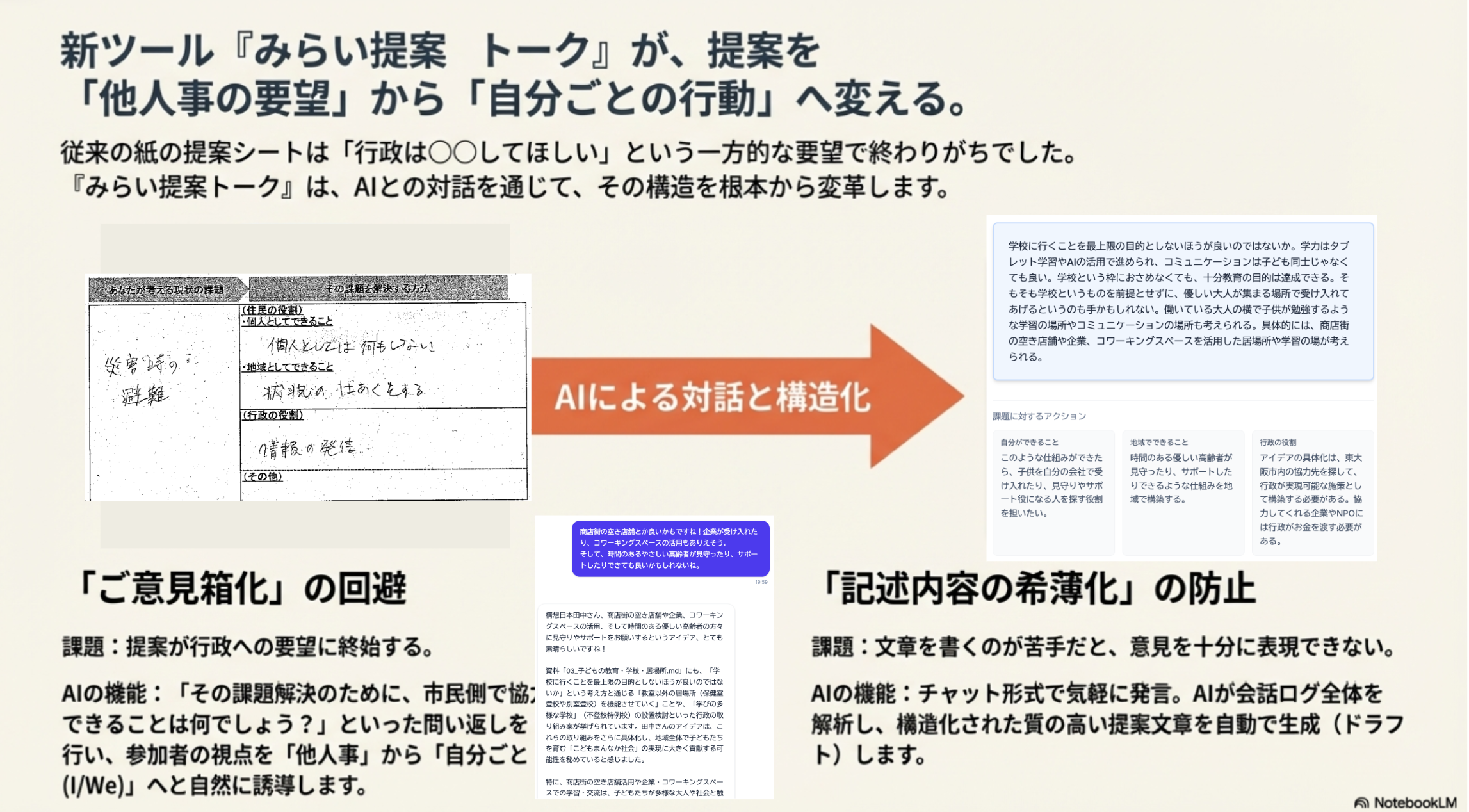
Its most important function is helping transform participants' views from requests into proposals. By asking, “Beyond what you want from the government, what do you think you or your community can do?”, AI encourages participants to recognize their own role.
Future Proposal Talk effectively generated a “personal report” for each participant. For people who found it difficult to articulate their ideas or tended to hold back in person, dialogue with AI helped organize their thoughts and supported them in putting ideas into words.
Recograph: Visualizing Discussions in Real Time
During group discussions, multiple groups talk in parallel. Under conventional methods, each group's discussion remains on recording sheets or whiteboards, but other groups cannot follow it in real time.
Recograph is an in-person meeting-minutes tool that visualizes group discussions in real time. By transcribing each table's discussion and structurally organizing keywords and issues, it produced the following benefits.
- Eliminating information gaps between groups: Participants could see issues raised by other groups, broadening discussion with observations such as, “That group has raised this point as well.”
- Reducing facilitator workload: Facilitators could focus on encouraging dialogue without being distracted by manual note-taking.
- Streamlining subsequent work: Text data forming the basis of post-meeting minutes was generated in real time.
Limitless: Automating Meeting Minutes
Preparing minutes is one of the most time-consuming parts of operating Residents Councils. Transcribing, organizing, and structuring participants' remarks previously took about one week after each meeting.
Limitless accurately transcribes meeting audio and automatically structures the minutes. It was used at Higashiosaka City's meetings for the following purposes.
- Real-time transcription: Converting remarks into text during meetings.
- Summarization and structuring: Automatically extracting key discussion points and organizing them by theme.
- Efficient preparation of materials: Substantially reducing KOSO NIPPON's workload in preparing reports and materials.
This freed KOSO NIPPON staff from the task of preparing minutes, allowing them to devote time to more essential work such as thoughtful participant follow-up and designing the next meeting.
Results: Visualizing Values and Changing Behavior
The integrated operation of conversational AI tools produced outcomes qualitatively different from conventional public-participation methods. Specific results follow.
Concrete Results from the First FY2025 Meeting
Forty-nine citizens, from junior high school students to people in their seventies, attended the first FY2025 meeting on October 5, 2025. Participants aged 18 and over were randomly selected, while junior high and high school students were selected from an open call, resulting in a diverse range of generations and backgrounds.
A particularly notable result was AI's function as a connection point for knowledge.
A representative example was an exchange about Ai Guard, a child-watching activity. When a participant asked about it, NotebookLM automatically integrated relevant city initiatives and presented the following information.
- The definition and implementation status of Ai Guard
- Connections to related crime-prevention and safety measures
- Its position among other local community activities
This information helped participants understand how a familiar local activity actually connects to citywide safety policy, deepening the discussion and making it more structural. AI bridged the gap to measures participants had overlooked.
Quantitative Results
Higashiosaka City's Residents Councils produced the following quantitative results.
- Approximately 500 AI dialogue sessions in total. Participants repeatedly engaged with AI, exploring issues roughly ten times per person (internal aggregate). This enabled repeated, in-depth collection of information that conventional surveys alone would struggle to obtain.
- A shift in insight depth. Dialogue moved from surface-level requests (“Fix the roads”) to underlying values (“I want a city where children can walk safely”).
- Active youth participation. Junior high school and university students articulated their own views through dialogue with AI. Younger participants who tended to hold back in person found it easier to express opinions in their own words.
The volume—approximately 500 dialogue sessions—is particularly noteworthy. Generating this much dialogue data from 49 participants indicates that individual AI dialogue was effective in approaching voices that could not be fully heard face to face.
Conventional surveys and one-off in-person meetings tend to yield limited information from each participant. Repeated exploration with the same participant through AI dialogue expanded the amount of information in a way that complemented face-to-face discussion.
Concrete Examples of Behavioral Change
The most important change from introducing conversational AI tools was a shift in participants' views from requests to proposals.
Before (Typical Requests Often Heard Before Introducing AI):
“Fix the roads.” “Do something about the dark streets at night.” “We need more places to have fun.”
After (Examples of Views That Became Proposals Through Dialogue):
“Could we create a school-route safety map in coordination with local child-watching activities?” “We would first like to draft our own proposal for using vacant shopping-district stores as places for junior high and high school students.” “Could nighttime safety be improved not only by installing security lights, but also by increasing the hours when people are present through initiatives such as neighborhood walking groups?”
This shift occurred because AI repeatedly asked, “What can you do yourself?”, changing participants' frame of mind from leaving matters to government toward taking personal ownership.
For participants who found it difficult to put their ideas into words, AI dialogue offered an entry point for organizing their thoughts. Supporting participants as they reconsidered their own values through dialogue was one of the initiative's goals.
Lessons Learned
The following insights from Higashiosaka City's Residents Councils should inform future AI-assisted initiatives.
Design Principles for Integrating Multiple AI Tools
The Higashiosaka City case revealed design principles for integrating multiple AI tools into Residents Councils.
1. Do Not Entrust Everything to One Tool
NotebookLM shared knowledge, Future Proposal Talk provided individual exploration, Recograph visualized discussions, and Limitless made recordkeeping more efficient. It is important to identify each tool's strengths and place it appropriately within the meeting flow.
2. Give Participants a Choice
Rather than requiring everyone to use AI tools, provide an environment where those who wish to use them can do so when they choose. Participants were free to decide whether to use Future Proposal Talk during breaks, and this voluntary nature helped ensure psychological safety.
3. Design the Data Flow
Plan in advance how data generated by each tool will be used in the next phase. For example, issues visualized by Recograph can serve as starting points for deeper exploration in Future Proposal Talk, while Limitless's meeting-minute data feeds into the design of the next meeting.
Supporting Facilitators, Not Replacing Them
One principle was upheld consistently throughout the project: AI supports facilitators; it does not replace them.
Determining the direction of discussion, attending to emotions among participants, and balancing the meeting as a whole are deeply human tasks that current AI cannot replace.
AI instead handled tasks that facilitators inherently wanted to perform but could not because of time and physical constraints.
- Carefully exploring each individual's views (Future Proposal Talk)
- Providing every participant with relevant government information at the appropriate time (NotebookLM)
- Visualizing the overall discussion in real time (Recograph)
- Keeping accurate records (Limitless)
Freed from these tasks, facilitators could focus on dialogue with participants, reading the room, and improving discussion quality—in other words, the essence of facilitation.
Implementing a Similar Use Case
Based on the Higashiosaka City implementation, the following steps outline adoption by other municipalities.
- Step 1: Review current meeting operations. Organize the current meeting format, number of participants, and types of deliverables, and assess facilitator staffing and workload.
- Step 2: Select tools and design a PoC. Consider which tool is effective at each stage of the meeting flow—before, during, and after. Start small with one tool, such as Future Proposal Talk, and assess its effectiveness.
- Step 3: Transition to integrated operation. Use the PoC results to design coordination among multiple tools. Train facilitators and prepare operating manuals to reduce dependence on individuals.
Would you like to learn more about this use case? Are you considering implementing something similar? Contact Plural Reality.
Platforms Used
Project overview
- Location
- Higashiosaka City, Osaka Prefecture
- Client
- Higashiosaka City
- Partner
- KOSO NIPPON
- Period
- October 2025–
Table of contents
Contact Form
Pricing by individual quotation
We prepare a quotation based on the scope of work, scale of use and support required. Tell us about the challenge you are working on.