
Key points
The AI in Cartographer handles drafting questions and organizing responses.
Cartographer is not a decision-making device; it is an assistive tool for creating a starting point for discussion.
AI drafts the questions and organizes the responses, but it is each individual who chooses whether to agree or disagree.
Updated
Overview
I am Shunsuke Takagi, Representative of Plural Reality LLC. In this article, I explain what AI does and does not do in our meeting support tool, Cartographer (Baisoku Kaigi), including our design decisions and its limitations. I will not exaggerate its role, and I will candidly share what we have not yet measured. I hope this serves as a basis for judgement in municipal settings and deliberation (careful discussion while sharing information).
- Author: Shunsuke Takagi (Representative, Plural Reality LLC)
- Verified on: November 27, 2026
- How this was made: Drafted with AI (Gemini) and verified by the author.
- If you notice any errors, please let us know at info@plural-reality.com (opens in a new tab).
What AI Does
The AI in Cartographer handles drafting questions and organizing responses. The overall flow is published in the Cartographer guide (opens in a new tab).
- Drafting questions: From a theme and background information, an LLM (large language model: an AI that generates and organizes text) drafts questions in the form of statements asking for agreement or disagreement. Organizers can check them in a preview and revise them before publishing and starting the session.
- Responding and helping put thoughts into words: Participants use their smartphones to choose from five options for each question: "Strongly agree", "Agree", "I don't know", "Disagree", and "Strongly disagree". For questions where their thoughts are not yet settled, they can choose "I don't know" and write in their own words. When doing so, the AI helps them put their opinions into words.
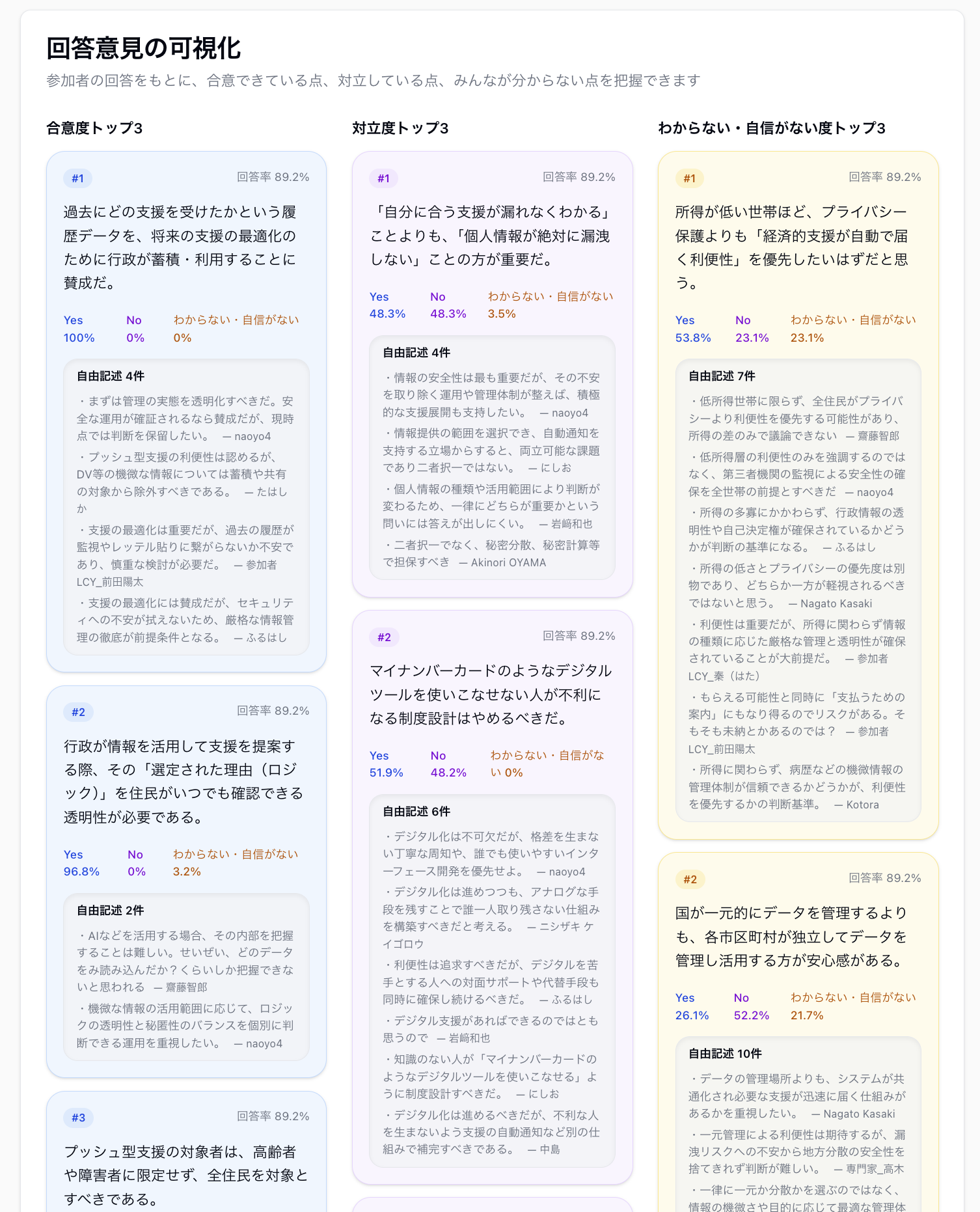
- Extracting and visualizing tendencies: From the responses, the tool automatically ranks the top three items by level of agreement, level of disagreement, and level of "I don't know". Furthermore, an LLM compiles points of agreement, points of difference, and points of uncertainty into a report. It also creates "My Report", which returns each participant's response tendencies, and a user map using PCA (principal component analysis: a statistical method for plotting response tendencies on a plane).
- Creating the next set of questions: It can also recreate questions for a second round based on a transcript of the discussion.
What AI Does Not Do
Cartographer is not a decision-making device; it is a support tool for creating a starting point for discussion. It is not designed to steer people toward a specific conclusion. Even when points of agreement or disagreement become visible, what to decide is determined through discussion by the participants and organizers.
In addition, what Cartographer shows is the distribution of views among the people who participated in that session. It cannot tell us the opinions of people who did not participate.
We uphold the Three Principles of AI Facilitation (opens in a new tab).
- Augmentation over automation: The role of AI is to extend the reach of the facilitator.
- Do not cut out time or friction: Time and the clash of opinions create the legitimacy of decisions.
- Verifiable by participants: AI summaries are presented in a form that participants can verify and challenge.
Regarding data handling, we configure the system so that inputs are not sent to providers that use them for model training. As an exception, Google may retain logs for up to 90 days for automated detection of suspected abuse.
Why "I don't know" Is an Official Option
In Cartographer, "I don't know" is an official option alongside the four levels of agreement and disagreement.
In deliberation, there are many issues where people cannot immediately decide whether they agree or disagree because they lack information or feel torn between values. I believe that forcing people to choose agree or disagree in such cases leaves behind numbers representing opinions they do not genuinely hold.
In the public data from DD2030 as well, over 20% answered "I don't know" on issues where judgement was deferred. I view the places where hesitation gathers most as the very issues that require additional explanation and dialogue.
Showing Both Agreement and Disagreement
I place importance on bringing disagreement into the open rather than hiding it—so that views remain traceable to what each individual actually said, rather than being smoothed over into an agreement that no one truly holds. If agreement comes, it should come afterward, not in place of it.
In the public data from DD2030 as well, both agreement and disagreement appeared clearly.
- Transparency on "reasons for selection": 97% Yes out of 31 votes (including "I don't know").
- Data use without individual consent: 50% Yes and 50% No out of 30 votes.
By showing points of convergence and points of division side by side, participants can share an understanding of where they should spend their time discussing.
External Perspectives
DemocracyNext's July 2026 paper (opens in a new tab) organizes seven capacities ("deliberative muscles") that support citizen deliberation. On pages 7 and 22, our tool (known internationally as Cartographer) is cited as an example of complementary AI use in "self-reflection" (reflecting on one's own thinking). This differs from "competitive use", which infers positions from demographics. It is positioned as structured pre-discussion questioning that prompts people to put tensions in their own values and reasoning into words. Page 24 also introduces how it is used in Japan to share individual reflections on a large screen after expert briefings and before small-group discussions, noting that this can help prevent the most confident and loudest voices from dominating.
At the same time, page 25 cautions that "even the complementary version could potentially become competitive if it is over-scripted." It points out that a reflection tool that steers people toward the same position produces self-examination that is merely compliance with the tool's framing.
While we do not design our tool to steer people toward a specific conclusion, the risk remains that over-scripting could edge closer to steering. We take this observation as an important warning.
It is also featured on Mozilla's cohort page (opens in a new tab), where it is introduced as a tool that uses an adaptive LLM questioning loop and PCA-based clustering (grouping similar tendencies) to map agreement, factual disputes, and value differences.
What We Have Not Yet Measured
As we also publish on our facts summary page (opens in a new tab), there are things we have not yet measured at this point.
- Comparison of deliberation quality: We have not conducted a controlled comparison under the same conditions between meetings that use the tool and those that do not. Assessments that "the discussion deepened" remain limited to feedback and observations from participants and facilitators.
- Whether participants reflect the broader population: We have not verified whether participants are a microcosm of all residents. As an example from a meeting that did not use Cartographer, Yosano Town sent invitations to 5,000 people and 43 participated. As noted in our FAQ (opens in a new tab), if outreach does not reach people, the number of respondents will not grow, and the composition of respondents does not necessarily represent the entire resident population.
- Time-saving effects: We have not measured this; any change in time required is only a rough indication based on operators' experience.
- Limitations of satisfaction scores and usage figures: As an example from meetings that did not use Cartographer, the 3rd and 4th sessions in Yosano Town had different content, so comparing satisfaction scores has limitations. Also, product usage figures such as "1,700+ participants" are cumulative record counts and include duplicates and test entries.
- How input is used in decisions: We have not tracked how opinions were used in decision-making. In Otoineppu Village as well, the process for returning responses to residents is still at the stage of being built.
People Make the Decisions
AI handles drafting questions and organizing responses, but each person chooses whether they agree or disagree. Participants decide the content of recommendations, and the administration or assembly decides whether to turn them into policy.
AI is not a device for ending discussion; it is a tool that prepares the ground so people can hesitate thoroughly and talk things through. We will continue improving Cartographer while verifying the boundary between what it can and cannot do.
Related Resources (Cartographer Public Scrapbox)
Detailed instructions on how to use Cartographer and feature updates (release notes) are compiled on our public Scrapbox.
- Statement highlights (ステートメントのハイライト) (opens in a new tab)
- Release notes: Opinion group visualization "My Report Map" and diagram view for AI reports (リリースノート:意見グループの可視化「じぶんレポート地図」と、AIレポートの図解表示) (opens in a new tab)
- Changing the tone, nuance, and wording of AI-generated "Session Reports" (AIが生成する「セッションレポート」のテイスト・ニュアンス・表現を変更する) (opens in a new tab)
- How to use Cartographer and release notes — Public Scrapbox (倍速会議の使い方とリリースノート(公開Scrapbox)) (opens in a new tab)
Frequently asked questions
- What does Cartographer's AI do?
- The AI in Cartographer handles drafting questions and organizing responses. Based on the theme and background information, a large language model (LLM) drafts questions in the form of statements inviting agreement or disagreement. Organizers can check the drafts in a preview before going live and edit them before starting the session.
- Does the AI decide conclusions or steer people toward a particular one?
- Cartographer is not a decision-making device; it is an assistive tool for creating a starting point for discussion. It is not designed to steer people toward a particular conclusion. Even when points of agreement and disagreement become visible, what to decide is determined through discussion by the participants and organizers.
- Why is "I don't know" an official option?
- In deliberative settings, there are many issues where people cannot immediately decide whether they agree or disagree because information is insufficient or values are in tension. I believe that forcing people to choose for or against in such situations leaves behind numbers representing opinions they do not genuinely hold.
- What has not yet been measured?
- We have not conducted comparisons under identical conditions between meetings that use the tool and those that do not. We have not verified whether participants are a representative cross-section of all residents. We have not tracked how opinions were used in decisions.
Try Cartographer
Cartographer is currently free, and you can try it in three minutes with just an email address.
Open the Cartographer site (opens in a new tab)