
Key points
This article documents what we did and what the published figures show across four published case studies (Yosano Town, Higashiosaka City, Digital Democracy 2030 (DD2030), and Otoineppu Village).
In Yosano Town, even where AI drafted proposals, we built in a process that preserved the original wording and had people check it.
What Cartographer shows is the distribution of views among those who participated in the session; it cannot tell us the opinions of those who did not participate.
Updated
Overview
This article records what was carried out and what we learned from published figures across four public cases involving Plural Reality LLC: Yosano Town, Higashiosaka City, Digital Democracy 2030 (DD2030), and Otoineppu Village. At the same time, it candidly reports the limitations that remain unknown, such as participation rates and impact evaluation.
At Plural Reality LLC, we work on utilizing AI tools in settings of resident participation and deliberation (forums where participants discuss based on information and deepen their thinking) in Japan.
- Author: Shunsuke Takagi (Representative, Plural Reality LLC)
- Last verified: November 27, 2026
- How this was made: Drafted with AI (Gemini) and verified by the author.
- If you notice any errors, please contact us at info@plural-reality.com (opens in a new tab).
Four Cases in Practice
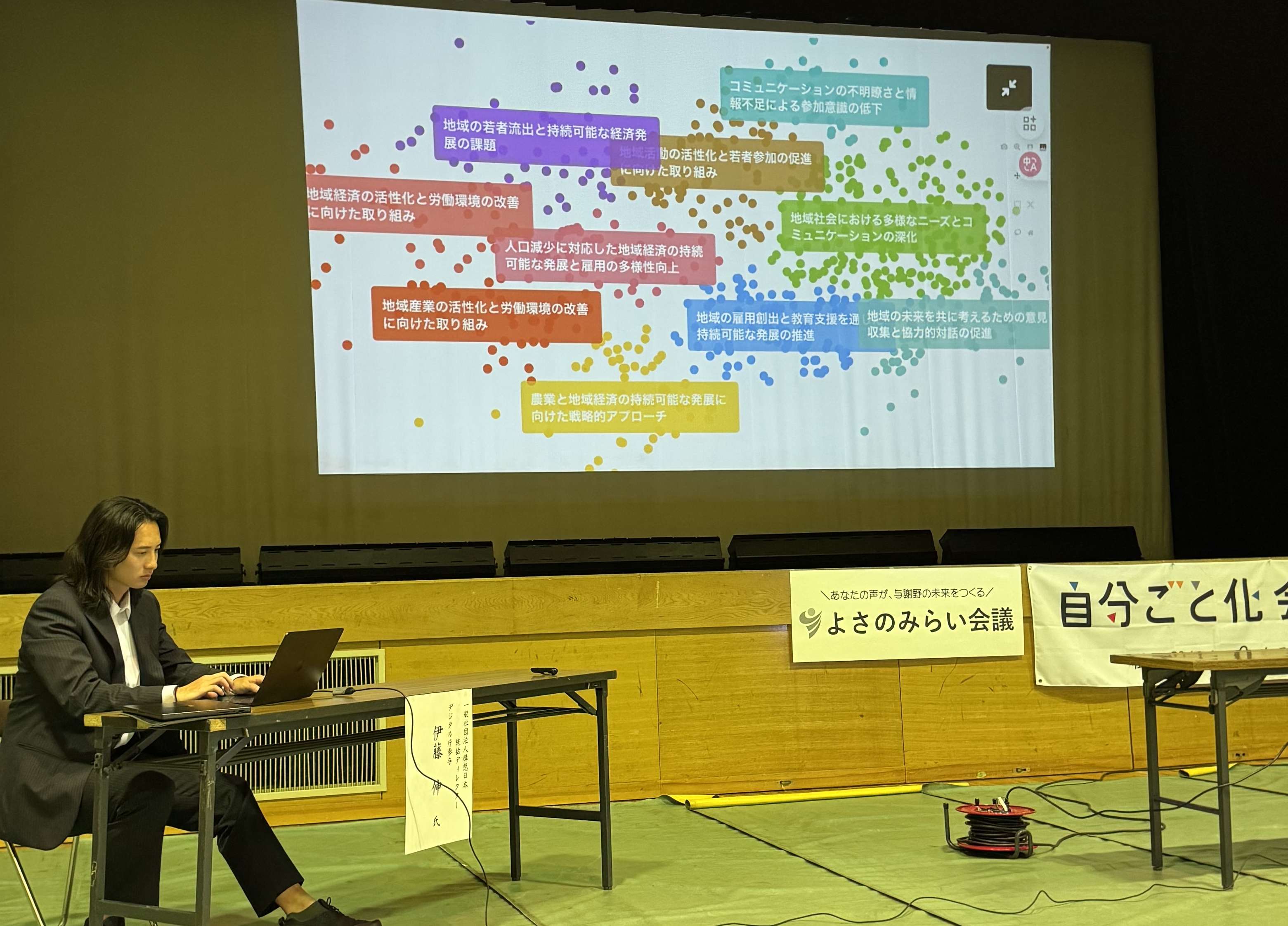
Yosano Town: A Randomly Sampled Residents' Assembly for the Comprehensive Plan
- Setting: In Yosano Town, northern Kyoto Prefecture (population approx. 20,000), a residents' assembly called "Yosano Mirai Kaigi" was held for the 3rd Comprehensive Plan (a basic plan formulated by a municipality on a multi-year basis; covering eight years starting in FY2027). It ran from September 14 to December 7, 2025, comprising four sessions (four hours each) plus one session for junior high and high school students. The operating partner was KOSO NIPPON, and we participated as technical support to KOSO NIPPON.
- Tools used: In this case, we did not use our product, Cartographer (Baisoku Kaigi). Instead, we used the following tools at each stage:
- Before the sessions: NotebookLM (over 30 official town documents)
- During the sessions: Recograph (graphic recording that visualizes discussions with drawings and text), Kouchou AI (a word cloud tool that shows overall trends by word frequency), and Limitless (real-time minutes)
- After the sessions: AI for drafting policy proposals
- Note that Kouchou AI is an open-source tool (a system where the program's blueprint is publicly available so anyone can use and modify it) developed by Digital Democracy 2030 (DD2030), not our product.
- Published figures: Invitations were sent to 5,000 residents aged 16 and older selected by random sampling (a method of randomly selecting people from a registry or list to invite), and 43 people ranging from their teens to their 70s and older participated. A total of 15 policy proposals were produced (3 subcommittees × 5 proposals). The satisfaction rate ("Very good") was 47.4% for Session 3 (20 respondents, valid responses excluding non-responses) and 59.1% for Session 4 (22 respondents, town tally).
- What we learned: Regarding what participants wrote on improvement proposal sheets, KOSO NIPPON's principle of "do not paraphrase" was appreciated by participants. In this case, we implemented a three-layer verification process: facilitators (discussion moderators) checked the AI-generated draft, participants gave final approval, and the original text was preserved. However, because the discussion topics differed between Session 3 and Session 4, the change in satisfaction does not isolate the effect of AI alone.
Higashiosaka City: Roundtables for the Children and Youth Plan
- Setting: In Higashiosaka City, to reflect citizens' voices in the Children and Youth Plan (a plan in which a municipality sets out support policies for children and young people), four sessions of the "Higashiosaka Regional Revitalization Roundtable" were held from October to December 2025. We were involved as technical support to KOSO NIPPON.
- Tools used: We used the conversational AI "Mirai Teian Talk." This is not included in our current product line. We also used NotebookLM, Recograph, and Limitless alongside it.
- Published figures: The first session of FY2025, held on October 5, 2025, had 49 participants. Participants ranged from junior high school students to people in their 70s; those aged 18 and older were randomly sampled, while the junior high and high school generation was recruited through open application. Conversations with AI on Mirai Teian Talk totaled roughly 500 interactions (around 10 per person). However, this figure is an internal tally and has not been published in a form that third parties can verify.
- What we learned: In a setting bringing together randomly sampled adults and junior high and high school students recruited by open application, participants engaged in around 10 interactions each. On the other hand, the count remains an internal tally and has not been published in a form that third parties can verify.
Digital Democracy 2030 (DD2030): Online Institutional Design Workshop
- Setting: On January 10, 2026, an online (Zoom) deliberation workshop lasting approximately three hours was held. The theme was the institutional design of push-type social security (a system in which the government proactively delivers necessary support without waiting for applications). Participants were citizen volunteers interested in digital democracy, including members of DD2030 and Code for Japan.
- Tools used: We used Cartographer in a two-round structure. After participants answered Round 1, they held small-group breakout discussions (discussions conducted by splitting into small groups), and AI generated new questions from the transcripts. This was followed by Round 2, further discussion, and plenary sharing.
- Published figures: There were 75 statements and 1,593 votes, which AI classified into 6 topics and 21 subtopics. The five facilitators leading the sessions were community members without specialized training in deliberation, operating under three requirements: "neutrality," "equal speaking opportunities," and "not stating their own opinions."
- What we learned: From the published data, issues with concentrated agreement and issues with divided opinions became visible in numbers.
- "Transparency allowing residents to check at any time why they were selected": Yes 97%
- "Use of data without individual consent (with notification)": Yes 50%, No 50%
- "Notifying the individual of AI's prediction of financial hardship": Yes 33%, No 42%, I don't know 25%
- In addition, five members without specialized training in deliberation facilitated the sessions by sharing the three requirements above (the quality of facilitation was not measured).
Otoineppu Village: A Residents' Assembly in a Village of 575 People
- Setting: Otoineppu Village in northern Hokkaido has a population of 575 (as of the end of August 2026). The village council has six seats, and all four of the most recent village council elections were uncontested (a situation where no vote is held because the number of candidates does not exceed the number of seats). On May 11, 2026, we held a residents' assembly titled "A Gathering to Discuss the Future of Otoineppu," asking: "If something disappeared, what would make it difficult to keep living here?"
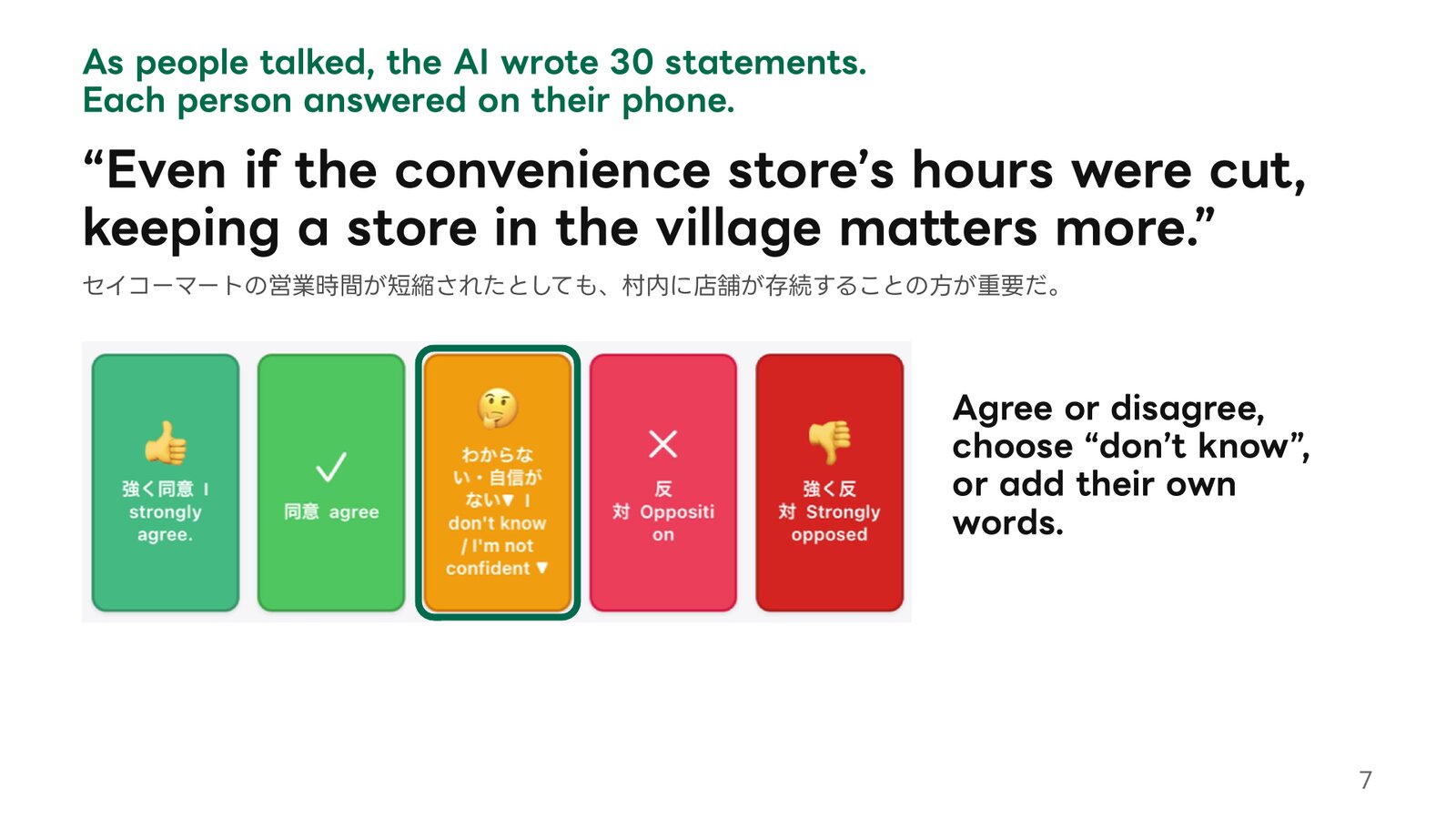
- Tools used: We used Cartographer. During the discussion, AI drafted 30 opinion statements, and each participant responded via smartphone with agree/disagree, "I don't know," and their own words.
- Published figures: There were 17 participants (including one of our team members), comprising high school students, older residents, newcomers who relocated to the village, municipal staff, and the village mayor. There were 30 opinion statements and 324 agree/disagree responses. For 7 out of the 30 statements, over 80% agreed, using all responses across the five options—including "I don't know"—as the denominator. For the statement "Even if opening hours are shorter, having a store within the village is more important," 13 out of 14 respondents (over 90%) agreed.
- What we learned: While keeping a store in the village drew broad agreement, opinions were divided on whether people would leave the village if the store or clinic closed. Some written responses expressed a desire to explore other ways to keep living there—such as collaborating with neighboring towns or securing transportation—before deciding to leave. We have also promised residents that we will deliver these opinions to the village office and council, return their responses to residents, and track how the input is used in decision-making; we are currently at the stage of building that process.
Cross-Cutting Observations
Across the four cases, the following three points have emerged so far.
- Verification processes that preserve original wording: In Yosano Town, even where AI drafted proposals, we incorporated KOSO NIPPON's "do not paraphrase" principle and a three-layer verification process, keeping the original text intact for human review.
- Visualizing opinion distribution and facilitation requirements: In DD2030 and Otoineppu Village, Cartographer enabled us to show in numbers both the issues where agreement concentrated and those where opinions diverged. In DD2030, five members without specialized training in deliberation also facilitated the sessions by sharing three requirements (the quality of facilitation was not measured).
- Complementary positioning and openness: DemocracyNext's paper Deliberative Muscles & AI (July 2026) cites Cartographer as an example of complementary AI use that supports self-reflection. In November 2026, we released the source code of Cartographer (the program code serving as the blueprint of the software) under AGPL-3.0, a license defining open-source release terms (GitHub (opens in a new tab)). We were also selected as one of 10 teams worldwide for the Mozilla Foundation's "Democracy x AI" incubator (a 12-month program supporting the launch and growth of new initiatives).
What Remains Unknown
On the other hand, many limitations remain that cannot be answered from the published figures alone.
- Participation rates and representativeness: As stated in our FAQ (opens in a new tab), if invitations to participate do not reach people, no method will increase the number of respondents. The makeup of respondents does not necessarily represent the resident population as a whole. For example, in Yosano Town, invitations were sent to 5,000 people and 43 participated, but the number of applicants and the participant cap are not listed on the case study page. In Otoineppu Village, one of the 17 participants was a member of our team. What Cartographer shows is the distribution of views among those who participated in that setting; it cannot tell us the opinions of those who did not participate.
- Unmeasured effects and time: Comparisons between sessions using Cartographer and those without it have not been measured. In Yosano Town, we did not verify whether participants were a microcosm of the overall resident population, nor can we conclude that the change in satisfaction was an effect of AI. The interaction count in Higashiosaka City also remains an internal tally. Furthermore, because conditions and data are not aligned, we have not been able to compare participation rates across the four cases.
- Reflection in decision-making and autonomous operation: The response from the village office and council and the tracking promised in Otoineppu Village are still at the stage of building the process. Whether another municipality can operate without our team is also untested. At MozFest 2026, we positioned this as a litmus test and put out a call for researchers to collaborate on evaluation, three municipalities for next year's trials, and support for our next fieldwork (research and practice conducted on site).
Links to Case Study Articles
- Yosano Town Case Study (opens in a new tab)
- Higashiosaka City Case Study (opens in a new tab)
- Digital Democracy 2030 (DD2030) Case Study (opens in a new tab)
- Otoineppu Village Case Study (opens in a new tab)
Related Resources (Cartographer's Public Scrapbox)
Detailed instructions for using Cartographer and feature updates (release notes) are compiled on our public Scrapbox.
Related case studies
Using AI to Overcome the Challenge of Translating Residents’ Voices into Policy
The source of the figures for invitations to 5,000 residents, 43 participants and four sessions.
Read articleBuilding a City Where Children and Young People Can Fulfill Their Dreams, Together with Citizens: Higashiosaka City's Effort to Uncover Honest Views Through Conversational AI
A case in which citizens held conversations with the conversational AI Mirai Teian Talk.
Read articleOpening Up Participatory Policy Deliberation with Cartographer: A Field Report
The source of the figures for 75 opinions, 1,593 votes and 6 topics.
Read articleOur work in Otoineppu
The source of the figures for a population of 575, 17 participants and 324 agree/disagree responses.
Read articleFrequently asked questions
- Was Cartographer used in Yosano Town?
- We did not use our product, Cartographer (Baisoku Kaigi). Instead, we used NotebookLM beforehand (with more than 30 official town documents); Recograph (graphic recording that visualizes discussions with illustrations and text), Kouchou AI (word clouds showing overall trends based on word frequency), and Limitless (real-time transcripts) during the sessions; and AI to draft initial policy proposals afterward.
- Do the participants represent all residents?
- The composition of those who responded does not necessarily represent the resident population as a whole. What Cartographer shows is the distribution of views among those who participated in the session; it cannot tell us the opinions of those who did not participate.
- Has the effect of using AI been measured?
- Comparisons between sessions using Cartographer and sessions without it have not been measured. In Yosano Town, we did not verify whether participants formed a representative microcosm of the town's population, nor can we conclude that the change in satisfaction was an effect of AI.
- What happens to the opinions from Otoineppu Village?
- We promised residents that we would deliver their opinions to the village office and assembly, bring the responses back to residents, and track how they are used in decision-making; we are currently at the stage of building that process.
Talk to us about your project
From designing a meeting or survey to running it, we help you decide where to start. Please contact us.
Contact us